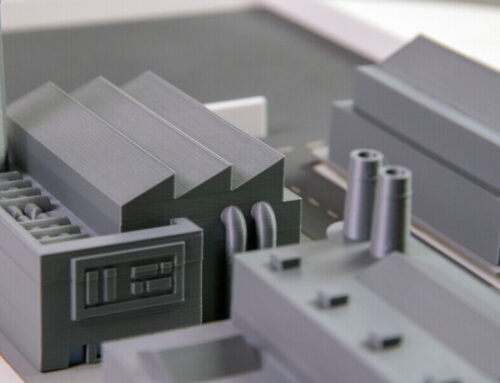
As the world transitions toward cleaner energy sources, renewable energy projects are becoming critical components of urban and rural planning. In this transformation, architectural models serve as powerful tools, not only for design exploration but also for communicating complex ideas to stakeholders, communities, and policymakers.
These models are increasingly being used to represent large-scale renewable energy systems like solar farms and hybrid systems such as agrivoltaic farming. By modeling these innovations, architects and engineers can visualize spatial relationships, assess environmental impacts, and optimize land use before ground is broken.

The role of Architectural Models in renewable energy
Architectural models—whether physical, digital, or hybrid—play a vital role in the planning and implementation of renewable energy infrastructure. They help to:
- Visualize scale and layout of energy systems within diverse landscapes.
- Test environmental interactions, such as sunlight angles, shading, and wind flow.
- Engage communities and stakeholders through tangible representations of abstract technologies.
- Facilitate interdisciplinary collaboration between architects, engineers, agronomists, and urban planners.
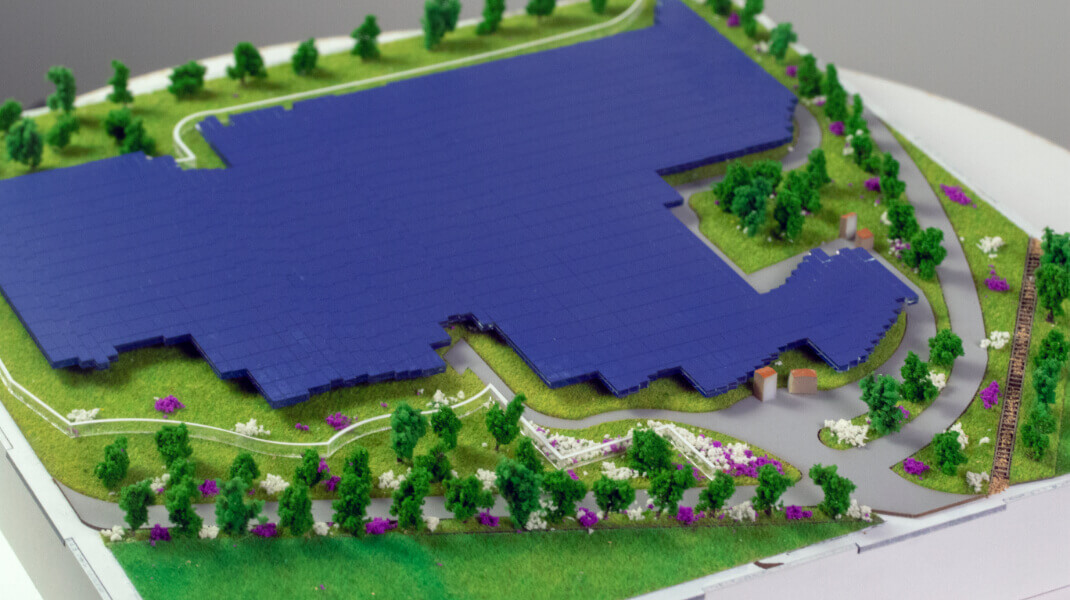
Solar power plant models
Solar power plants, often comprising thousands of photovoltaic (PV) panels, must be precisely designed to maximize efficiency and minimize land disruption. Architectural models of solar farms allow planners to:
Key Features:
- Simulate topographical alignment to adapt panel arrays to sloped or irregular terrains.
- Analyze sun path and shadow studies using 3D simulation tools (like Rhino+Grasshopper or SketchUp+Heliodon).
- Model electrical infrastructure including inverters, battery storage units, and grid connections.
- Visualize landscape integration, showing how solar arrays coexist with roads, vegetation buffers, and service structures.
Benefits:
- Supports regulatory approval by clearly communicating environmental and spatial impacts.
- Helps in site selection by assessing shading, soil quality, and access to transmission lines.
- Allows public engagement through scaled visualizations that demystify the project’s presence.
Architectural models are evolving to meet the needs of a rapidly changing energy landscape. By embracing detailed representations of solar power plants and agrivoltaic systems, designers can promote a vision of infrastructure that is not only functional but also sustainable and visually harmonious with its surroundings.

These models are not just tools, they are catalysts for innovation, understanding, and action in the renewable energy revolution.