As the world continues to grapple with the challenges of climate change and sustainable energy solutions, innovative approaches are emerging to address the dual concerns of agricultural productivity and renewable energy generation.
One such groundbreaking concept is the agrivoltaic solar farms – an integration of solar panels with agricultural practices. This symbiotic relationship not only enhances the efficiency of land use but also offers numerous environmental and economic benefits. Before embarking on the construction of these unique farms, the use of scale models proves to be an indispensable tool for optimization and planning.
Agrivoltaic Solar Farm:
Agrivoltaics, also known as agrophotovoltaics, involve the co-location of solar panels and agricultural activities on the same piece of land. Traditional solar farms often compete for valuable space with agriculture, leading to concerns about land use conflicts.
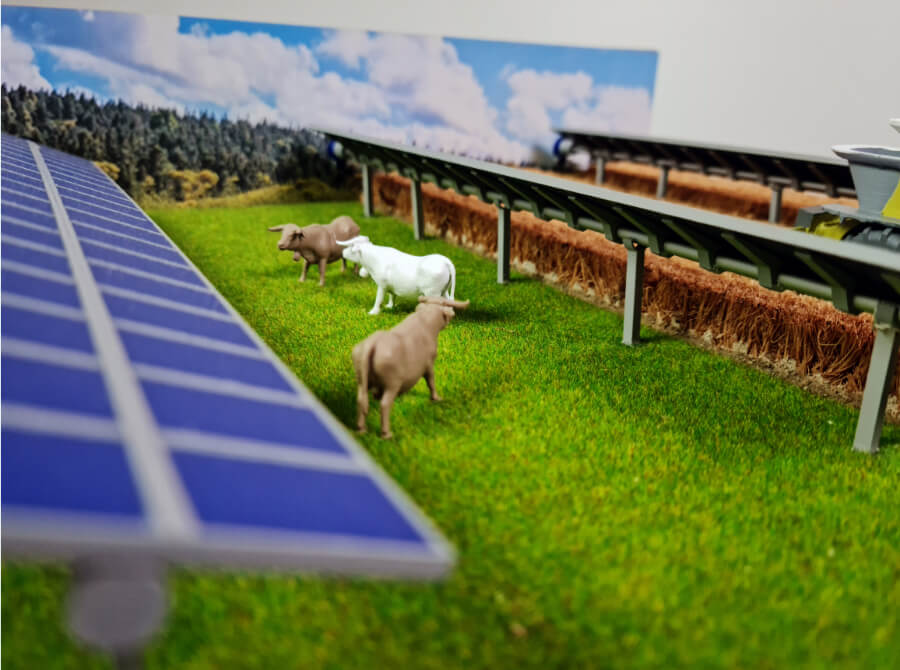
In an Agrivoltaic Solar Farm, solar panels are elevated, allowing sunlight to filter through to the crops below. This innovative approach not only maximizes land utilization but also brings about several advantages:
Increased land productivity:
Agrivoltaics enable the dual use of land for both energy production and agricultural cultivation. This dual-use approach enhances overall land productivity, making it a more sustainable and efficient use of resources.

- Crop yield improvement:
Studies have shown that certain crops thrive under the partial shade provided by solar panels. The moderated sunlight conditions contribute to reduced water evaporation, better temperature control, and decreased wind speed, creating an ideal microclimate for crops.
- Water conservation:
The shading effect of solar panels in agrivoltaic systems helps in reducing water requirements for crops, promoting water conservation. This is particularly significant in regions facing water scarcity or drought conditions.
- Reduced land footprint:
Agrivoltaic systems make efficient use of available land, addressing concerns about land use competition between agriculture and renewable energy projects. This, in turn, mitigates the environmental impact associated with large-scale solar installations.

Advantages of scale models in agrivoltaic solar farm planning:
Before breaking ground on a full-scale Agrivoltaic Solar Farm, the use of scale models proves instrumental in optimizing the design and layout. Here are some key advantages:
Spatial optimization:
Scale models allow planners to visualize and experiment with different spatial arrangements of solar panels and crops. This optimization ensures that the solar panels do not overshadow critical areas for crop growth, maximizing sunlight exposure for agricultural activities.
Microclimate analysis:
Detailed scale models facilitate the study of microclimates created within the agrivoltaic system. This includes assessing temperature variations, wind patterns, and humidity levels, helping farmers and engineers make informed decisions about crop selection and placement.
Efficiency assessment:
By using scale models, planners can simulate and analyze the energy production efficiency of the solar panels under various conditions. This information is crucial for fine-tuning the layout to achieve the optimal balance between energy generation and agricultural productivity.
Community engagement:
Scale models serve as powerful communication tools, allowing stakeholders, local communities, and decision-makers to visualize the proposed agrivoltaic solar farm. This fosters community engagement and understanding, addressing concerns and garnering support for the sustainable project.
Have questions or specific requirements for your architectural scale model?

The Agrivoltaic Solar Farm represents a harmonious blend of agriculture and renewable energy, offering a sustainable solution to the challenges of land use and resource optimization.
Before these innovative farms become a reality, the use of scale models plays a pivotal role in refining designs, optimizing layouts, and ensuring that the symbiotic relationship between solar panels and agriculture is maximized for the benefit of both the environment and local communities.
As the world strives for a more sustainable future, the agrivoltaic model stands out as a beacon of innovation, with scale models guiding the way towards its successful implementation.